Ancient of Days
Now, and forevermore.

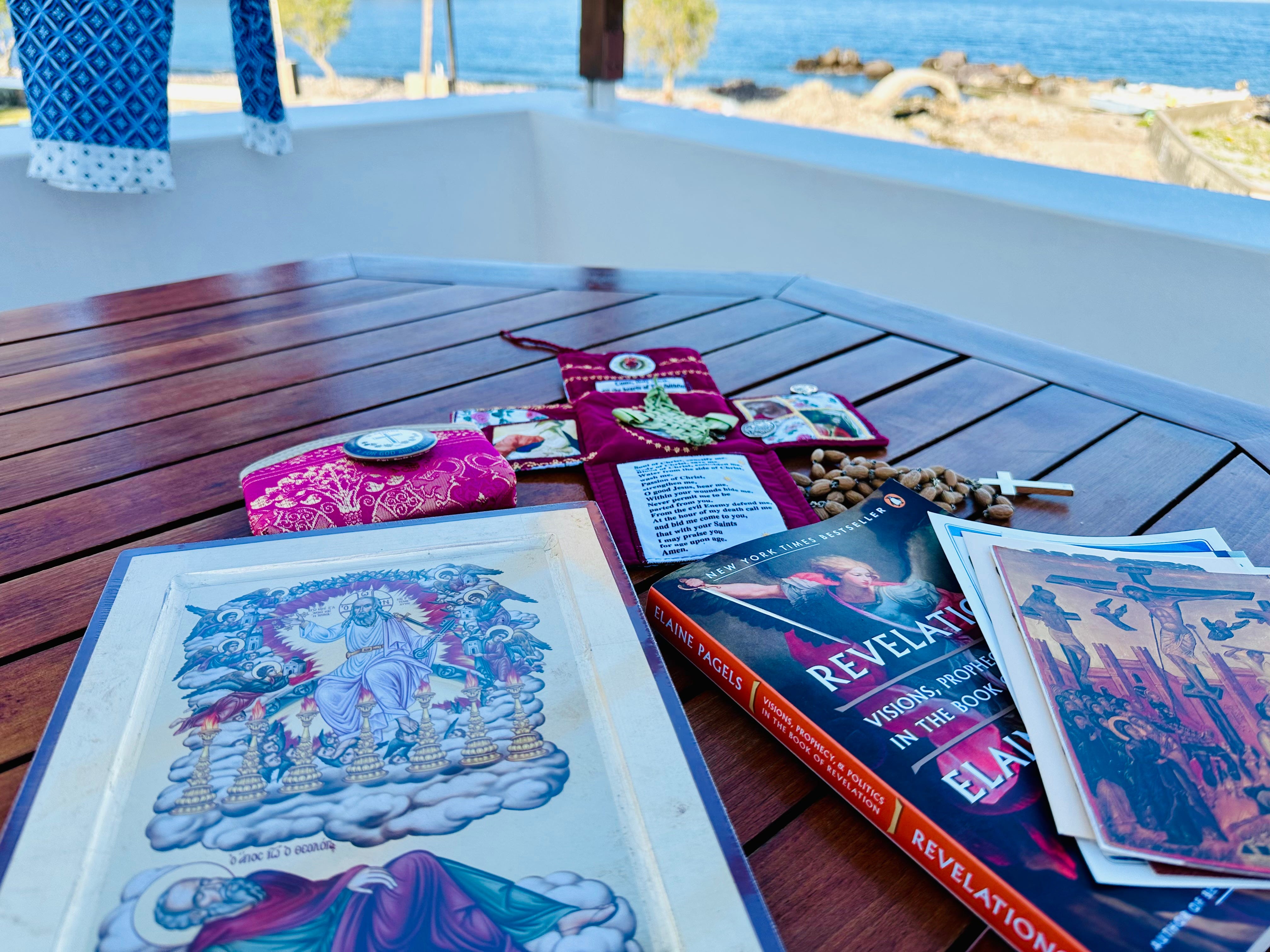
There are places on this beloved planet where time does not pass so much as it gathers—layer upon layer, like incense caught in stone—and Patmos is such a place. An island rooted in a living, breathing ancient faith, where the memory of pirate raids and the necessity of defence still whisper through fortress walls, and yet where, just beyond those same walls, reverent ceremony unfolds in quiet constancy. Here, the sacred is not curated; it is inhabited. It lingers in the whitewashed, labyrinthine lanes, in the rhythm of bells and footsteps, in the way doors open to spring light as though answering a call that has been sounding for centuries.
We are staying in a sweet ocean-side studio where the Aegean does not only lap at the shore—it sings. There is a hush to it, a maternal cadence, a lullaby that rises and falls through the open windows while we sleep, as if the sea herself were keeping vigil. In this in-between time—before the full arrival of the tourist season—the island feels poised on a threshold: quiet, preparatory, expectant. Freshly whitewashed homes gleam with renewal, their brightness not yet worn by the press of summer. Wildflowers cascade with abandon down the mountainside There is a sense here of something about to begin. We are here during the Orthodox Holy Week. On Thursday, we are told, pilgrims both domestic and foreign, will spill forth from the ferries. Coming from far and wide to touch and be touched by this jewel of the Aegean. Until then, the mood is one of gathering.
And into this gentle unfolding came Raphael, our private guide—scholarly, animated, and quietly devout. Archangel Raphael lends him not only a name but a certain bearing, as though he too carries messages between worlds. He told stories not as one reciting history, but as one who has lived among its echoes. Through him, the island revealed itself not as a relic, but as a continuity.
The monastery—Monastery of Saint John the Theologian—is a vessel. It hums with prayer. Cantors’ voices rise and fall like breath itself, and the air is thick with incense and the tender fragrance of spring flowers, as though heaven and earth had agreed, here at least, to meet without resistance. Within its museum, and library, treasures beyond measure are held not as artifacts, but as presences. The world with all its strife, pauses here, and is given an orientation.
Two icons, in particular, undid me.
The first: the “Christ Anapeson.” The infant Christ, smiling in sleep, attended by His mother, who gently fans Him, and an angel who stands at His head bearing the instruments of His suffering—the sword, the thorn branch, the cross. Here, in pigment and wood, is the whole mystery: innocence already marked by sacrifice, tenderness shadowed by destiny. It is almost unbearable, this mingling of sweetness and sorrow, as though love itself were revealing its cost before the child could speak.
The second: “Behold the Man.” The Ecce Homo. Christ in His humility, His surrender, His utter willingness. Not the triumphant king, but the exposed and offering one. The man. I was told that this very icon will be carried through the streets on Maundy Thursday, blessing all who gather in faith. The image does not remain confined to walls; it walks among the people, as He once did.
And all of this—every note of incense, every flicker of candlelight, every story told—prepared me for the descent into the cave.
The Cave of the Apocalypse is not grand. It does not overwhelm by scale or opulence. Instead, it draws you inward, downward, into a kind of listening that feels older than thought. I lit long beeswax candles for my loves, each flame a small, trembling act of devotion. I carry much in my work as an analyst, and today, I carried it all here. Carried it and offered it up to something grander than us all. And then, there, before us, the cleft in the stone—threefold, mysterious, as though the rock itself had yielded to a voice too vast to contain. It is said that here the divine word was spoken, that here the veil thinned enough for eternity to be heard. St. John listened.
Nearby, on the left, the chapel of Anna, mother of Mary—another quiet lineage of faith, another hidden root. A grand-mother, a crone.
And then the place where John the Apostle is said to have written: In the beginning was the Word, and the Word was made flesh. A place where he received the Revelations: And I saw the holy city, the new Jerusalem, coming down out of heaven from God, prepared as a bride adorned for her husband. I placed my rosary into the cleft, into that wound in the granite that once opened to receive the voice of God. I let it rest there, if only for a moment, as though it might remember something older than my own prayer. I touched the stone where John himself is said to have grasped in order to rise again, as though the body, even then, needed something solid to hold in the presence of the infinite.
And then Raphael, with the quiet ingenuity of our age, illuminated with his cell phone a image almost hidden in the shadows: the “Ancient of Days.” Christ as an old man. White-haired, eternal, beyond the constraints of time—pre-incarnate, transfigured, the Alpha and the Omega held in a single gaze. I wept again, not from sorrow, but from recognition. The convergence was unmistakable. The Sage. The Crone. The long arc of my own work and longing. It was as though the image was not merely seen, but seeing—meeting me across time, across text, across the hidden architecture of my own life.
I was not only looking. I was being looked upon. More tears. Deeper sobbing.
Moments later, the cave grew quieter, Raphael leaving us to our prayers. There was only us, my husband of 25 years and I, before the icon of “Ancient of Days”. I fingered my rosary and began to pray. My husband breathing quietly behind me. The Sorrowful Mysteries. The Luminous Mysteries. The rhythm of the rosary, bead by bead, word by word, anchoring us in a lineage that has endured both empire and exile.
And then he came.
The monk who tends the cave. Old, bent, clothed in sweeping black robes that seemed to carry the weight of years. The hem as mud stained as his boots. His presence was not theatrical; it was human, fragile, and utterly real. He approached us with a hand pressed to his heart, his eyes lifted in a kind of pleading that needed no translation.
“Very hard day today. Pray for me, please.”
There are moments when the sacred does not appear as light or vision, but as a simple request. He comes clothed in mud and sorrow. We placed our hands on our hearts and promised—not only here, not only now, but beyond this place, beyond this hour.
When we finished our prayers and ascended toward the threshold, out of the darkness and into the light, he was there again, as though waiting not to be seen, but to be remembered.
“After here,” he said, “pray for me.”
We would later learn that he had been the headmaster of the elementary school, that he tends not only this cave but his elderly mother, that he carries responsibilities both visible and hidden. Our guide had once been his student. “He was a good headmaster”, he remembered. The continuity again—the ancient and the immediate, the holy and the human, the teacher and the student, woven together without seam.
And so I will pray for him. For him, and for all those who carry unseen burdens in sacred places. For those who tend the fire when others come only to warm themselves by it. For those who sweep the stones, who light the candles, who remain when the pilgrims have gone.
Here, on this island where the past is not past, where the Word once broke open the rock and continues to echo in the hearts of those who listen, I find myself standing in that same cleft—held between what has been, what is, and what is still becoming.
The Alpha and the Omega.
And somewhere within that vastness, a quiet, enduring call:
After here, pray for me.
Muriel, your words feel like a descent into the pregnant darkness with a lamp held steady … the kind of sacred entering that Jungians know deep in the marrow of their bones. The way you carry light into the cave, into the cleft, into the human sorrow of the monk … moved me deeply.
It’s as though you let that ancient cave look back at you and answered with your whole being. Thank you so much for letting us witness a journey where the holy and the human meet without seam … and where your own devotion becomes part of the illumination. Never stop writing! 🙏💖